

Erectile dysfunction (ED) is a biomedical condition with psychological consequences and relational ramifications. Although it is often framed as a vascular or neuroendocrine disorder, ED rarely affects only the man experiencing it. Instead, it alters the dynamic equilibrium of romantic relationships, influences communication patterns, reshapes intimacy, and can erode the couple’s sense of cohesion. For this reason, the evaluation of ED therapies increasingly goes beyond metrics such as penile rigidity or response time. Modern research now recognizes that relationship well-being—shared satisfaction, communication, stability, and emotional closeness—plays a critical role in treatment outcomes.
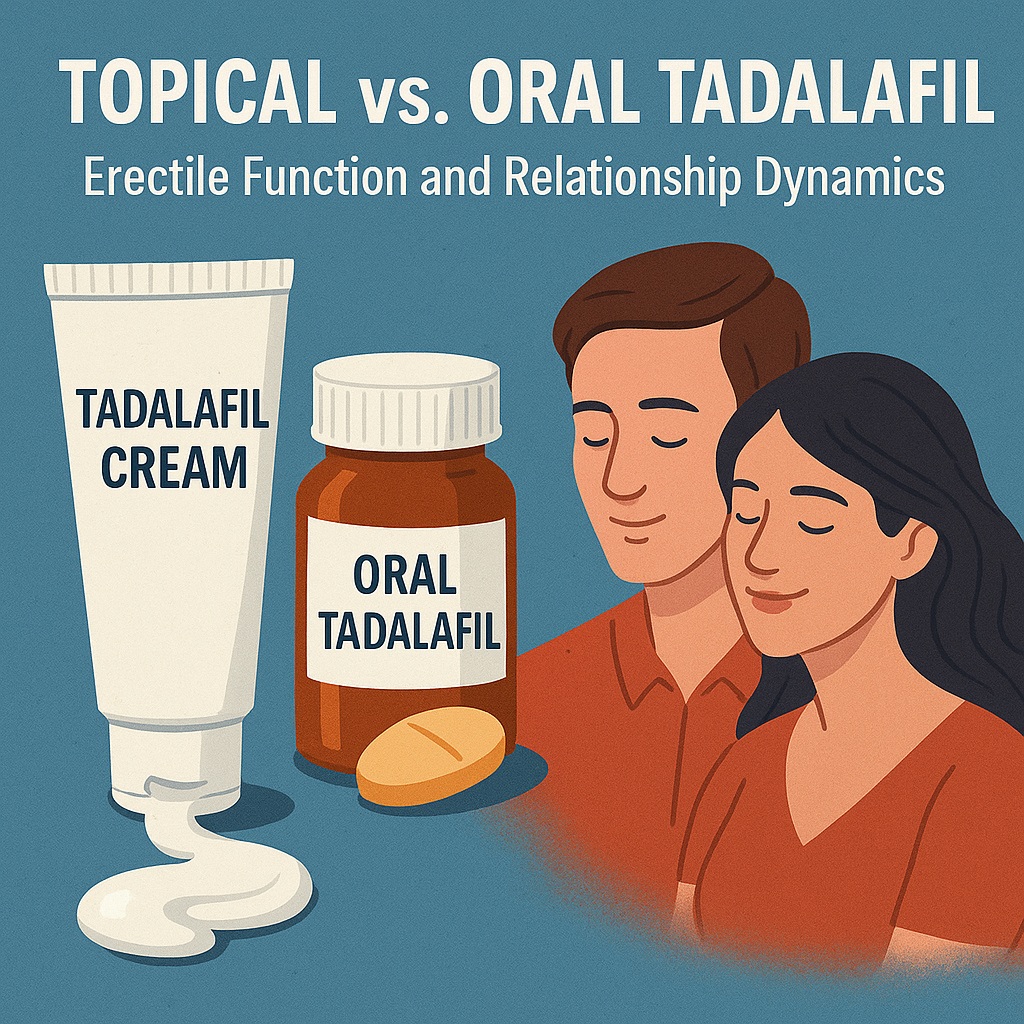
The randomized crossover trial analyzed in this study takes an important step forward by comparing two formulations of tadalafil—oral and topical cream—not solely on their physiological effects but also on their impact on dyadic adjustment. This secondary analysis seeks to determine whether the method of drug delivery influences relational satisfaction, conflict resolution, mutual support, and overall couple functioning. In other words, the study explores whether how men take tadalafil is as important as whether the drug works.
This article synthesizes, interprets, and expands the significance of the trial’s findings. It aims to offer clinicians, sexual health researchers, and mental health practitioners a comprehensive understanding of how tadalafil cream and oral tadalafil compare—not only in erectile function but also in the relational landscape in which ED exists.
Why Relationship Dynamics Matter in Erectile Dysfunction Treatment
Sexual function does not operate in isolation. Any intervention for ED influences, and is influenced by, the relational environment of the couple. Decades of clinical work demonstrate that ED can become a shared stressor, especially in long-term partnerships. Couples often adapt by reducing sexual contact, avoiding intimacy to prevent performance anxiety, or shifting emotional distance to protect the partner’s feelings. These changes can reduce satisfaction for both individuals.
The Dyadic Adjustment Scale (DAS-32), used in this trial, captures four key domains that shape long-term relational health:
- Consensus (agreement on important matters)
- Satisfaction (overall happiness with the relationship)
- Cohesion (shared activities and emotional bonding)
- Affectional Expression (comfort in expressing love, affection, and sexuality)
Unlike traditional ED studies, this trial evaluates how each tadalafil formulation affects these deeper components of intimacy—an innovative layer that bridges pharmacology and relational psychology.
The rationale for exploring topical versus oral routes is also important. The two formulations differ in onset of action, practicality, side effect profile, and psychological meaning. Some men perceive oral medication as a symbol of illness, while a topical cream may feel more integrated and less medicalized. Others find the cream intrusive. These subjective interpretations can impact sexual confidence and partner interaction.
Study Design and Methodological Framework
The trial employed a randomized crossover design, one of the most powerful approaches for comparative analysis because each participant serves as his own control. This design minimizes interindividual variability and isolates the differential effects of the two drug forms more clearly.
Participants
A total of 32 men with clinically diagnosed ED completed all phases of the study, each participating along with their female partner. This inclusion of partners strengthens the validity of the relational measures, ensuring that DAS-32 responses reflect shared experience rather than unilateral perception.
Interventions
Participants received both:
- Oral tadalafil 5 mg daily
- Topical tadalafil cream (Erogral™)
Each formulation was administered for 8 weeks, separated by a washout period to eliminate carryover effects.
Assessment Tools
- DAS-32 for relationship dynamics
- IIEF-5 and IIEF-15 for erectile function
- EDITS questionnaire for patient satisfaction
- Side effect profiles assessed at each visit
One strength of the study is its multidimensional assessment strategy, which integrates physical, emotional, and relational domains.
Baseline Characteristics: A Well-Matched Sample for Comparative Analysis
Baseline DAS-32 scores showed no significant differences between groups prior to treatment, ensuring that relational dynamics were comparable before intervention. Mean scores for consensus, satisfaction, cohesion, and affectional expression all fell within mid-range values, suggesting moderately stable relationships with room for improvement.
The baseline sexual satisfaction levels, as measured by IIEF and EDITS, did not differ significantly either, indicating that any subsequent changes resulted from the interventions rather than pre-existing group differences.
This careful matching is essential for ensuring reliability of the crossover comparison.
Tadalafil and Dyadic Adjustment: What the Study Found
Overall DAS-32 Improvement
Both oral and topical tadalafil led to significant improvements in total DAS-32 scores. This confirms that effective ED treatment, regardless of route, enhances relationship satisfaction and cohesion. Sexual function is relationally consequential, and its restoration improves communication, reduces frustration, and increases emotional closeness.
However, topline similarity masks important nuances.
Affectional Expression: Topical Tadalafil Outperforms Oral Form
The most notable finding is that topical tadalafil cream led to a significantly greater improvement in affectional expression, a domain reflecting comfort with physical affection, sexual openness, emotional warmth, and intimacy-building behaviors.
According to the authors:
“The topical formulation was associated with a statistically significant greater positive change in affectional expression scores compared with oral tadalafil.”
Why would this domain improve more with a cream?
Possible explanations include:
- Increased partner involvement — applying cream may naturally encourage mutual participation, tactile contact, or shared sexual preparation.
- Reduced medicalization — cream may feel less like “taking a pill for a problem,” decreasing performance anxiety.
- Localized action — men may perceive cream as directly addressing penile function, increasing confidence and enhancing willingness to engage in intimacy.
Consensus and Satisfaction
Improvements in consensus (shared agreement) and satisfaction (relationship happiness) were similar between formulations. This suggests that ED treatment itself—not the route—is the key driver of relational harmony. As sexual confidence returns, partners communicate more openly, reduce avoidance, and regain mutual reinforcement patterns, regardless of whether the drug is taken orally or applied topically.
Cohesion
Cohesion improved in both groups as well. Greater cohesion likely results from increased shared activities, physical closeness, and emotional bonding once ED is effectively managed.
Erectile Function Outcomes: Comparable but Characteristically Distinct Improvements
Oral vs. Topical: What Did the Trial Show?
Both oral tadalafil and topical cream significantly improved IIEF scores, but the magnitude and pattern of this improvement differed subtly.
- Oral tadalafil produced slightly more consistent improvements in erectile rigidity and penetrative ability due to stable systemic levels.
- Topical tadalafil showed faster onset and stronger perceived local effect according to participant reports, enhancing confidence early in treatment.
However, these physiological differences were not large enough to dominate the relational outcomes.
Patient Satisfaction and Perceived Treatment Experience
The EDITS questionnaire revealed consistently high satisfaction for both formulations. Yet qualitative feedback captured in the study elaborates on different experiential benefits:
- Men using oral tadalafil appreciated the convenience and routine of daily dosing.
- Men using topical tadalafil valued the local control and the sense of targeted action.
Interestingly, some participants reported that the cream made sexual encounters feel more intentional or sensual due to the application process, which may explain the superior improvement in affectional expression.
Side Effects and Tolerability
Side effect differences highlight the practical implications:
- Oral tadalafil produced expected systemic side effects such as headache, flushing, and dyspepsia in a minority of participants.
- Topical tadalafil occasionally caused localized erythema or mild burning but nearly eliminated systemic adverse effects.
For men who experience intolerable systemic side effects from oral PDE5 inhibitors, the cream may represent a therapeutic alternative with a more favorable safety profile.
Interpreting the Differences Through a Psychosexual Lens
The central question of the study—why does topical tadalafil improve affectional expression more than oral forms?—can be explored through psychosexual frameworks.
1. Embodied Sexuality
Topical application situates the intervention within the sexual body rather than within systemic biology. This may enhance a man’s sense of agency, physicality, and erotic presence.
2. Partner Engagement
Partners often participate in cream application, which provides:
- tactile stimulation,
- co-regulation of anxiety,
- shared involvement in the treatment,
- increased emotional bonding.
3. Reduced Clinical Pathologization
Oral medication can symbolically reinforce the perception of ED as “disease,” whereas cream may feel more like part of normal sexual preparation.
4. Conditioning and Ritual
Some men experience improved arousal due to the sensory ritual of applying cream before intimacy. This ritual may serve as a “gateway cue” to relaxation, sensuality, and connective behaviors.
Clinical Implications: Integrating Topical Tadalafil Into ED Treatment
A dual-outcome therapy
Topical tadalafil is not merely a physiological alternative to pills; it offers a distinct relational advantage. For couples seeking not only improved erections but enhanced emotional closeness and expressive intimacy, topical formulations may be uniquely valuable.
When to choose topical tadalafil
- Partners desire mutual involvement.
- Men prefer localized therapy without systemic side effects.
- ED is accompanied by relational distance or emotional withdrawal.
- There is apprehension around taking daily oral medication.
When oral tadalafil remains the better option
- Men need steady systemic pharmacodynamics.
- Predictability and hands-off convenience are prioritized.
- Severe vascular ED requires continuous plasma-level modulation.
A combined or alternating approach?
The crossover design suggests men could use topical tadalafil in settings where intimacy-building and partner engagement are desired, while relying on oral tadalafil when convenience is needed. This application-specific strategy deserves future exploration.
Strengths and Limitations of the Study
Strengths
- Inclusion of both partners for relationship assessment
- Crossover design reducing between-subject variability
- Multidimensional evaluation of physiological and relational outcomes
- Novel comparison of topical vs. oral formulations
Limitations
- Small sample size (32 couples)
- Short treatment blocks (8 weeks each)
- Absence of placebo control
- Limited diversity in participant demographics
Nevertheless, the study provides valuable, clinically relevant insights into ED’s relational dimensions.
Conclusion: Delivery Route Matters—Not Only for Physiology but for Relationship Quality
This trial offers a rare and important finding: the formulation of ED therapy can influence relationship dynamics beyond improvements in erectile function alone. While both oral and topical tadalafil enhanced erectile performance and overall relationship satisfaction, topical tadalafil produced significantly greater improvement in affectional expression—and thus in intimate emotional communication.
For clinicians, this means ED treatment should not be approached as purely biomedical. The choice between oral and topical therapy can meaningfully shape relational experience. For couples, this study validates that ED therapy influences not only erections but closeness, warmth, connection, and the shared emotional life of the partnership.
Topical tadalafil emerges as a promising modality for men and couples seeking a therapeutic option that integrates sexual function and emotional intimacy—advancing a more holistic, couple-centered model of care.
FAQ
1. Is tadalafil cream as effective as oral tadalafil for improving erections?
Yes. The study shows that both forms significantly improve erectile function, with no major difference in overall efficacy. Topical cream may have a faster perceived onset, while oral tadalafil provides consistent systemic effects.
2. Why does topical tadalafil improve affectional expression more than oral tadalafil?
Because the cream encourages tactile interaction, increases partner involvement, reduces medicalization of sex, and supports embodied intimacy. These relational factors enhance affectional behaviors in ways oral medication does not.
3. Who should consider using topical tadalafil?
Men who experience systemic side effects from oral PDE5 inhibitors, couples seeking increased intimacy or shared sexual preparation rituals, and patients preferring localized therapy may benefit most from topical formulations.
